
BlogAI & agents
GEO vs SEO: what changes when AI answers instead of Google
Generative engine optimization is mostly SEO with a different reader. What the research behind the term actually found, what stays the same, the four things that change, and what we skip.
glokki team4 min read
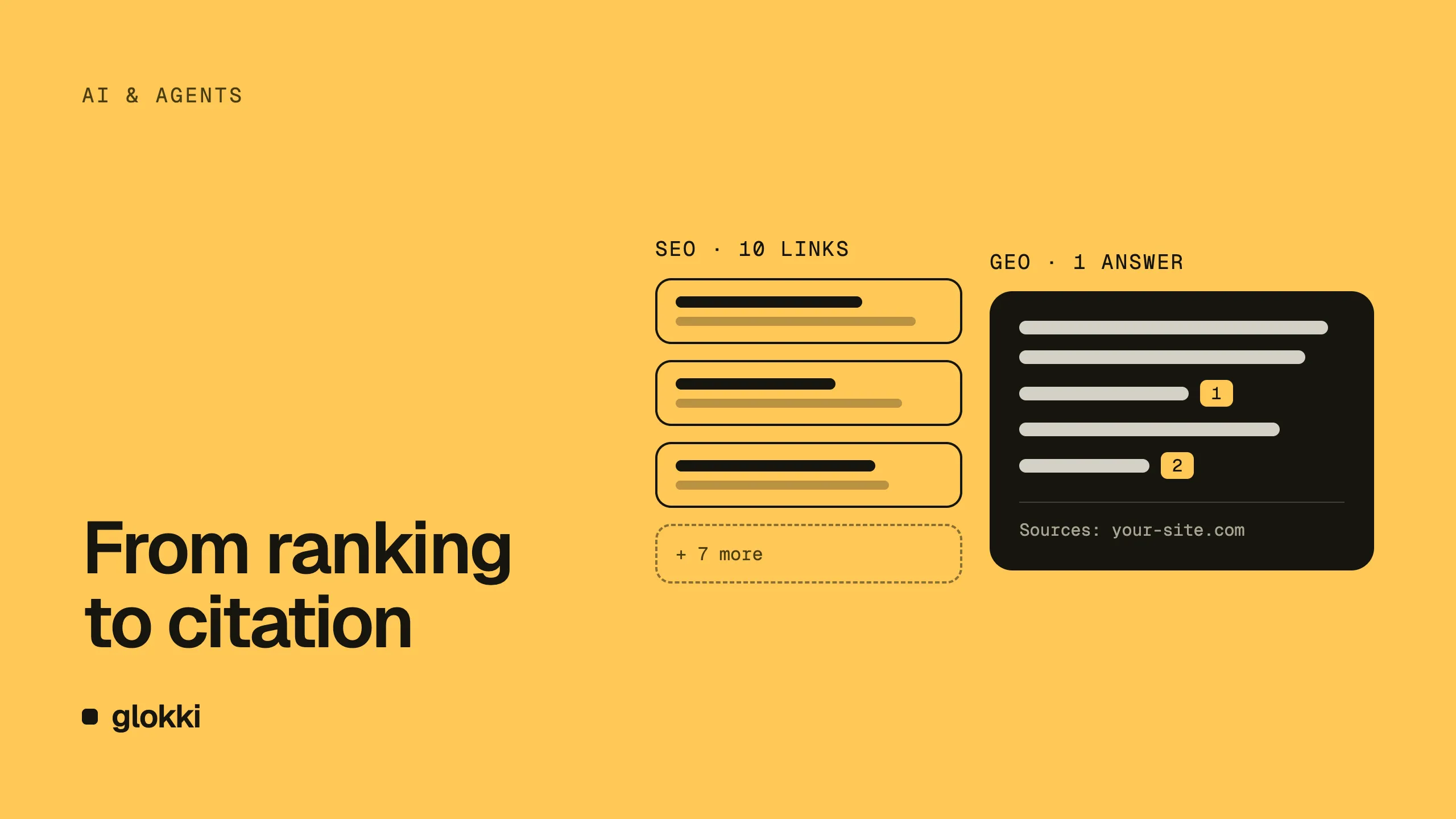
When someone asks an assistant instead of a search engine, the result isn't a list of ten links. It's one answer, written from a handful of pages, with a few citations if you're lucky. "Generative engine optimization", or GEO, is the name for trying to be one of those pages.
Is it a new discipline, or SEO with a new name? Mostly the latter, with a few real differences. Here's where we draw the line.
Where the term comes from
The term comes from a research paper, GEO: Generative Engine Optimization (Aggarwal et al., KDD 2024). The authors built a benchmark of queries, rewrote source pages in different ways and measured how much of each page made it into AI-generated answers. The findings worth knowing:
- Evidence helped most. Adding quotations, statistics and cited sources to a page did best, about 41% above the baseline on their main visibility measure.
- Keyword stuffing didn't work. It gave little to no improvement, and on Perplexity it scored below the baseline.
- It depends on the domain. What worked for one kind of question didn't necessarily work for another.
Keep the setting in mind: a 2023 benchmark, mostly a simulated engine, and one live test on Perplexity. It's a useful direction, not a rulebook for whatever ChatGPT or Gemini do this month.
What stays the same
An assistant can only cite a page it can find and read. Most of the work is still plain SEO:
- Pages are crawlable and indexable. Assistants use search indexes or
fetch pages live. A stray
noindex, a page that only renders in JavaScript, or a broken sitemap hurts both. - One page answers one question. Clear titles, headings that say what the section is about, and the answer before the background.
- Canonical URLs and honest metadata. Duplicates and misleading descriptions confuse a model as much as a crawler.
- Fast, stable pages. An agent fetching a dozen pages for one answer won't wait for yours.
If your SEO basics are broken, fix those first. No GEO trick makes up for a page nobody can fetch.
What changes
1. The unit is the passage, not the page. A search engine ranks your page. An assistant lifts a paragraph or two from it. Sections that make sense on their own, with the answer stated plainly near the top, are easier to quote than an argument that only works read from the beginning.
2. Evidence beats phrasing. This is what the paper found: numbers, named sources and quotes made pages more likely to be used. That's also just good writing. "The docs sidebar is much lighter now" is weaker than "about 3 KB instead of 420 KB, measured on 25 October".
3. Machine-readable versions help. A model reading your HTML spends its
budget on navigation, scripts and class names. A Markdown version of the
page, an llms.txt index and JSON-LD stating what the page is all lower the
cost of reading you. We covered how glokki.com does each in
How to make your website discoverable by AI.
One caveat: llms.txt is a proposal, and it's not clear which assistants
read it. It's cheap to add, so we do.
4. Success looks different. In search, the goal is a click. In an AI
answer, it's being cited, and sometimes the person never visits. When they
do, the visit usually shows up with the assistant as the referrer, e.g.
chatgpt.com or perplexity.ai. Watching those referrers is the simplest
measure there is. Ours show up in the CMS
page analytics like any other source.
SEO and GEO side by side
| SEO | GEO | |
|---|---|---|
| Reader | Ranking algorithm, then a person | A model writing an answer |
| Unit | Page | Passage |
| Win | A click from the results page | A citation in the answer |
| What helps | Relevance, links, speed, clean markup | The same, plus evidence, self-contained sections, Markdown and structured data |
| What doesn't | Thin pages, keyword stuffing | Thin pages, keyword stuffing |
What we skip
- Guarantees. Nobody controls what an assistant cites. Anyone promising a spot in ChatGPT's answers is guessing.
- Writing for the model instead of the reader. Pages stuffed with "according to experts" phrasing are the AI-era version of keyword stuffing. The research doesn't support it, and readers notice.
- Hiding content from people. Text that only crawlers see is a risk in search and gains nothing with assistants.
A short checklist
- No
noindexon pages you want found; a sitemap that lists them. - Each page answers one question, near the top.
- Sections that still make sense when quoted alone.
- Numbers, sources and dates where you make a claim.
- Markdown versions,
llms.txtand JSON-LD if your stack makes them cheap. - Watch for assistant referrers in your analytics.
glokki gives you points 5 and 6 out of the box, and the Markdown for agents guide shows the setup. The rest is writing.
Create a free account and see how your pages read to an assistant.