
BlogComparisons
Contentful alternatives without usage-based pricing
Contentful Lite is $300 a month with paid overages of $5 per 1M API calls and $0.15 per GB, and a Lite Space adds $850. Free has hard caps; Enterprise is custom.
glokki team9 min read
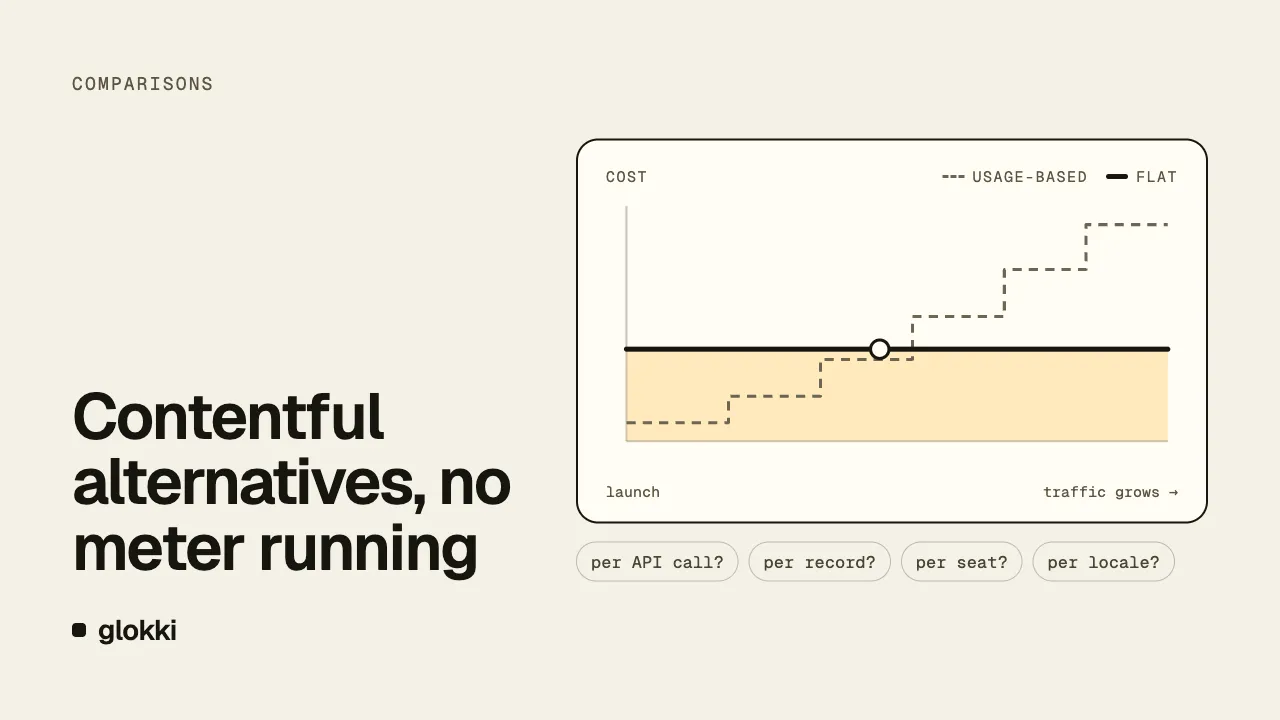
If your bill rises with usage, start with self-hosted Payload or the MIT-licensed Puck editor. Neither vendor lists a usage-based charge for them, but your own hosting bill can still rise with traffic. Storyblok Growth, paid Prismic plans and Puck Cloud have a usage-based part, and Plasmic's is not confirmed. Storyblok Growth Plus has no overages but blocks spaces at a limit. glokki is free during the beta, and we don't give a pricing model for after it.
As of 1 November 2026, Contentful Free has hard usage caps instead of paid overages. Lite is $300 a month with paid overages: $5 per additional 1 million API calls and $0.15 per additional GB of asset bandwidth. A Lite Space is an add-on at $850 a month on top of Lite. Enterprise has custom pricing.
We build glokki, so read this list with that in mind. We checked the competitor data on 1 November 2026. We didn't run any of the other options for this comparison; the data comes from each vendor's public pages and docs.
This isn't a list of options with no usage-based billing, because the data doesn't support one. Self-hosted Payload and the Puck editor come without a usage-based part listed by the vendor, and both leave you paying for your own infrastructure. Some plans elsewhere also have no overages: Storyblok Growth Plus blocks spaces at a limit, and Prismic Free locks the project when you use up its allowance.
How the options compare
The order runs from options where the vendor lists no usage-based part, through those where it lists one or doesn't say, to staying put and then our own product. The last column names where each option beats glokki.
| Option | Billing model | Usage-based part | At the limit | Beats glokki on |
|---|---|---|---|---|
| Payload | Self-hosted is free, "for free, forever". Enterprise has no published amount | Self-hosted: none listed by the vendor, and your hosting bill depends on your own infrastructure. Enterprise: not confirmed | Self-hosted: no vendor limit listed, so it depends on your host. Enterprise: not confirmed | Self-hosting, MIT, installs in your Next.js app |
| Puck | Core editor under MIT, with no listed price. Puck Cloud (AI Copilot and API): metered, $199 /month, $799 /month or custom | Editor: none listed on Puck's pricing page or home page. Puck Cloud: AI usage in tokens, with pay-as-you-go at token cost plus 20% | Puck Cloud: requests billed through Puck pause until you add credit. Traffic limits: not confirmed | Core editor under MIT, data in your own backend |
| Plasmic | Free $0. Billed yearly: Starter $39, Pro $103, Scale $399 /month. Enterprise is custom | Not confirmed. Counts page views for Headless API content, but doesn't list a limit or a charge for them | Doesn't list traffic limits, so not confirmed | Plasmic hosting or third-party servers, published paid plans |
| Prismic | Per repository, paid annually: Free $0, Starter $10, Small $25, Medium $150, Platinum $675 /month. Enterprise is custom | Paid plans: CDN bandwidth overages at $0.30/GB, or $0.25/GB on Platinum. Free: no overages. | Paid plans: overages up to a hard limit, then an automatic move to the next plan. Free: the project locks. Using up API calls: not confirmed | Published plans and limits, components for Next.js, Nuxt and SvelteKit |
| Storyblok | Per space. Starter is free. Growth $99.00 /mo or $90.75 /mo billed annually. Growth Plus $349.00 /mo or $319.91 /mo billed annually. Premium and Elite have custom pricing | Yes on Growth: $10 per 1M API requests, $75 per 250GB of traffic, and a $/€1,000 Maximum Usage Breach Fee. Growth Plus: no overages | Growth: the pricing page lists maximums of 5M API requests and 1TB, but the Overage Fees Fact Sheet says: "There is no cap on overage charges." We couldn't confirm how the two fit together. Growth Plus: spaces are blocked at a limit | SDKs beyond React, published plans and overage rates, and a published uptime percentage in its service level agreement (SLA). We found no published SLA in the glokki product materials we read |
| Contentful | Free $0. Lite $300 /month. Lite Space add-on +$850 /month. Enterprise is custom | Free: none, hard usage caps. Lite: overages at $5 per 1M API calls and $0.15/GB of asset bandwidth. Enterprise: custom | Free: hard usage caps. Lite: paid overages. An upper limit on overages and what happens at record or content type limits: not confirmed | Published plans and overage rates, up to a 99.99% uptime SLA on Enterprise. We found no published SLA in the glokki product materials we read |
| glokki | Free plan, free during the beta. The editor has no payments or billing. Paid plans will follow after the beta, and we don't give a model for them | Nothing to bill today, because the editor has no billing | Code search only: rate limits per 60 seconds, and calls over them to our Model Context Protocol (MCP) server get 429 or RATE_LIMITED. Production not confirmed | n/a |
Payload
Payload installs in a new or existing Next.js app and is MIT licensed. The vendor offers self-hosting "for free, forever" and lists no traffic, API or bandwidth limits for it.
You deploy it anywhere you can run a Node.js app, so your bill follows your own hosting. Payload's get-started page gives no amounts for that. Enterprise has no published amount, and its limits aren't confirmed. Payload Cloud isn't a way to start today, because deployment of new projects is paused.
Pick it if you want the CMS inside your own Next.js app and your data in a database you run, and your team can pay for that infrastructure.
Puck
Puck's core editor is under MIT, and the pricing page lists no price for it. You store and serve its output from your own backend, so that's the infrastructure you run and pay for.
Puck Cloud is separate, and it covers AI Copilot and API. Pay-as-you-go is metered at token cost plus 20%, and requests billed through Puck pause until you add credit. Launch is $199 a month and Growth is $799 a month, and both can use your own model key at token cost plus 0%.
We couldn't confirm any traffic limits. We also couldn't confirm whether Launch and Growth include credit, or whether the 20% fee applies to them without your own key.
Pick it if you want a React editor under an MIT license and already have a backend for its output.
Plasmic
Plasmic's pricing page doesn't list traffic, API or bandwidth limits for any plan. That doesn't mean there aren't any, so we can't say whether it has a usage-based part. It counts page views for content delivered via the Headless API, but it doesn't list a limit or a charge for them. The only extra charge it shows is per collaborator: $20 on Pro and $40 on Scale. It doesn't say if those amounts depend on yearly billing.
Billed yearly, Starter is $39, Pro is $103 and Scale is $399 a month. You can use Plasmic hosting or deploy to third-party servers. The repo is MIT outside platform/ and AGPL in platform/.
Pick it if you want a choice of hosting and a published plan, and Plasmic first tells you whether it has traffic limits.
Prismic
Prismic's plans are per repository and paid annually: Free is $0, Starter $10, Small $25, Medium $150 and Platinum $675 a month. Paid plans have a usage-based part, though a limited one. You pay CDN bandwidth overages at $0.30/GB, or $0.25/GB on Platinum, up to a hard limit. At that limit, Prismic moves you automatically to the next plan. Free has no overages, and the project locks when you use up the allowance.
Included bandwidth is 100GB on Free, Starter and Small, 500GB on Medium and 1TB on Platinum. Platinum can also pay API call overages up to 20 million on yearly invoiced plans, at a rate we couldn't confirm. We also couldn't confirm what happens when you use up API calls. Prismic has display components for Next.js, Nuxt and SvelteKit.
Pick it if you want a low published entry price, your stack includes Nuxt or SvelteKit, and an automatic move to the next plan is acceptable.
Storyblok
Storyblok's subscriptions are based on spaces, and Growth has a usage-based part. Growth is $99.00 a month, or $90.75 billed annually, with 400GB of traffic and 1M API requests. Above that, you pay $10 per 1M API requests and $75 per 250GB of traffic, up to the listed maximums of 5M requests and 1TB. Extra locales, seats and AI credits also cost more, but stories and assets aren't an overage on Growth.
Storyblok's Overage Fees Fact Sheet also says: "There is no cap on overage charges." We couldn't confirm how that fits with the listed maximums. Overage fees are charged monthly, even on an annual plan.
Growth also has a $/€1,000 Maximum Usage Breach Fee. A footnote in Storyblok's plan fact sheet says it applies when self-service customers exceed the API and traffic limit in two consecutive months. How it's charged and what happens at the maximum remain unconfirmed. You can watch usage in the dashboard, but you can't set usage alerts there.
Growth Plus is $349.00 a month, or $319.91 billed annually, with fixed limits of 1TB of traffic and 4M API requests. It has no overages, and spaces are blocked when they reach a limit. Growth Plus subscriptions created before Sep 10, 2026 keep their previous limits. To go higher, you move to Premium or Elite, which have custom pricing.
Storyblok's docs list SDKs for React, Astro, Nuxt, Vue, Svelte and Angular. Its uptime SLA is 97% on Growth and Growth Plus, 99.9% on Premium and 99.99% on Elite. We found no published SLA in the glokki product materials we read.
Pick it if your sites use more than React or you need a published uptime SLA. You also have to accept overage on Growth with a cap we couldn't confirm, or a block at Growth Plus limits.
Staying on Contentful
As of 1 November 2026, Contentful Free includes 100K API calls and 50 GB of asset bandwidth a month, with hard usage caps instead of paid overages. Lite is $300 a month and includes 1M API calls and 100 GB of asset bandwidth. Above those, you pay $5 per additional 1 million API calls and $0.15 per additional GB of asset bandwidth. A Lite Space is an add-on at $850 a month on top of Lite. Enterprise has custom pricing.
Before you move anything, compare your last few invoices with your plan's limits. Moving is work, and it only makes sense if those numbers give you a reason.
Pick it if your current bill and limits fit your team, and your recent bills were close to what you expected.
glokki
The Free plan is free during the beta and covers full editing and publishing. Signing up doesn't need a card, and the editor has no payments or billing. Paid plans will follow after the beta. We don't give amounts, a date or a billing model for them, so today's state tells you nothing about later bills.
We searched our code on 1 November 2026. It has rate limits per 60 seconds, and in the directories we checked we found no monthly limits on traffic, requests, bandwidth, pages or storage, and no overage charges. That's a code search result and not a product promise, and we didn't confirm that production behaves the same way. Other limits exist, such as one free organization per account and 50 MB per file.
Blocks are your React components, declared with defineBlock() and a Zod schema. The CMS is hosted, and you host your site.
Pick it if you're on Next.js or React, want a hosted CMS with schemas in code, and can accept a beta with no published terms for its paid plans.
When glokki isn't the right choice
- Your site isn't on Next.js or React. Our docs and SDK cover only those two.
- You want to host the editor yourself. The CMS is hosted, and you can't run the editor on your own servers.
- You need access to the source code. Our code is closed and will stay closed.
- You want an importer. There's no automated importer, so you move content yourself.
- You need a long track record. glokki is in beta.
- You need to know the pricing model after the beta. We don't give it. If predictable long-term bills are your main reason for moving, that counts against us today.
- You need A/B testing. It's only on the Enterprise plan; a new organization doesn't get it.
- You need AI features. They're Pro and above, and the product has no billing, so you can't buy Pro yourself today.
Where to go next
If you're still comparing CMSs in general, read about headless CMS options for Next.js teams. For options picked by other criteria, see the longer Storyblok alternatives list.
To test glokki on one page of your own site, create an account.